Claude :: Week 5 :: New vs. Certified Pre-Owned: Let AI Make the Case
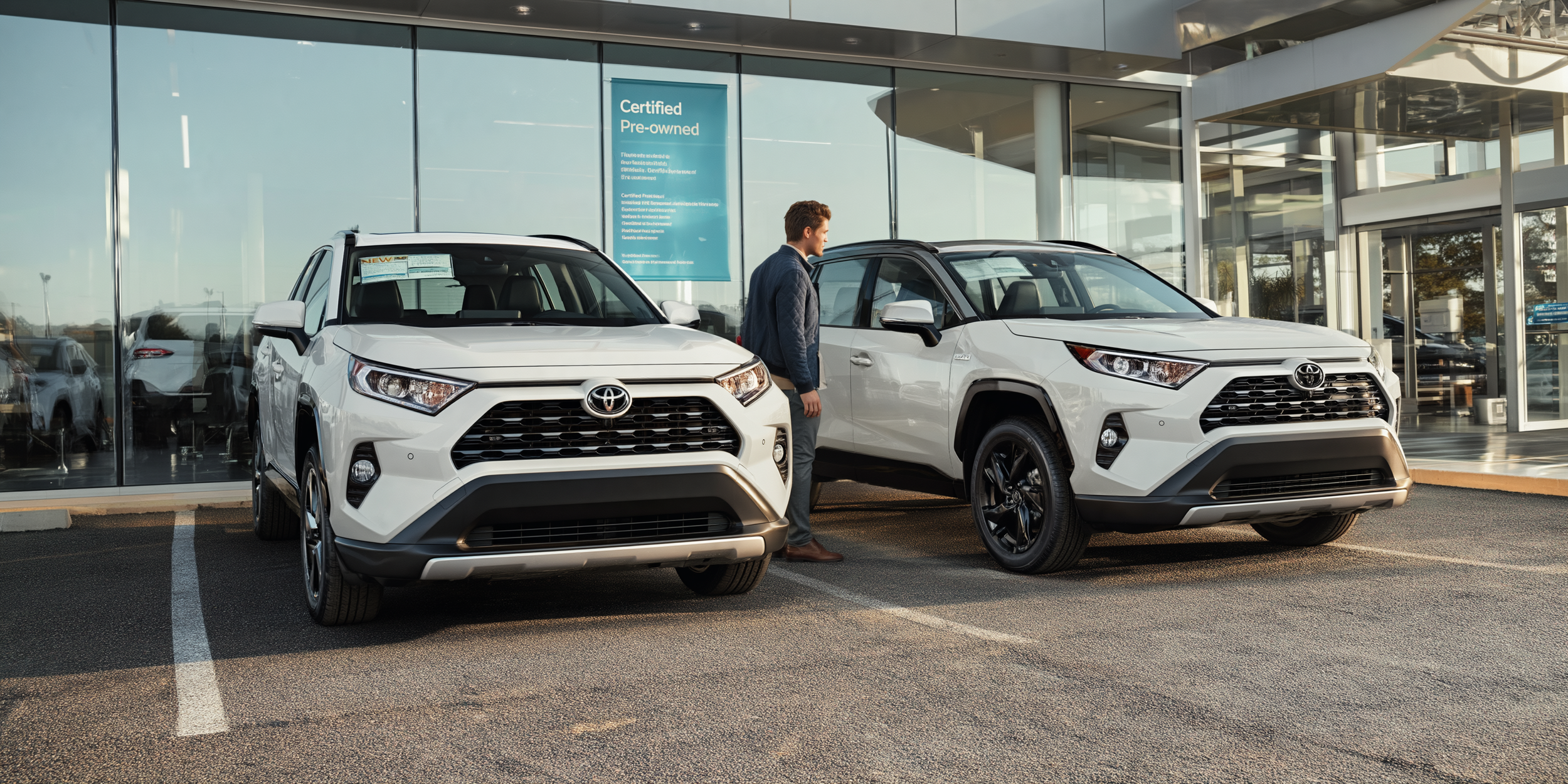
Post Summary and Introduction
SUMMARY: Every variation in this week's post attacks the same high-stakes question — should you buy new or certified pre-owned? — but each one meets you where you are in the decision process and gives you a progressively sharper set of analytical tools. Variation 1 (Beginner) is your starting line: hand the AI your budget, credit score, and priorities, and it argues both sides of the new-vs.-CPO debate before committing to a clear recommendation with specific models — no "it depends" hedging allowed. Variation 2 (Intermediate) picks up where Week 1 left off, feeding your confirmed financial parameters into a four-section intelligence report that includes model-specific cost comparisons, a CPO program evaluation that exposes the critical difference between manufacturer certification and dealer marketing labels, a three-vehicle shortlist, and red flags to watch for on the lot. Variation 3 (Advanced) treats your purchase as a capital expenditure decision: a multi-deliverable analytical engine that builds weighted decision matrices with depreciation crossover-point analysis, forensic CPO program audits including dealer economics, scored vehicle shortlists calibrated to your priority stack, and a four-category risk assessment covering financial, mechanical, market, and warranty-gap exposure. If you want a confident recommendation in ten minutes, start with Variation 1; if you want a working document you can carry into the dealership, run Variation 2; if you are deploying $40,000 or more and want to audit every assumption before you sign, Variation 3 is your framework.
The Variation 1 (Beginner) Variation 1 (Beginner) is your starting line: hand the AI your budget, credit score, and priorities, and it argues both sides of the new-vs.-CPO debate before committing to a clear recommendation with specific models — no "it depends" hedging allowed.
The Variation 2 (Intermediate) Variation 2 (Intermediate) picks up where Week 1 left off, feeding your confirmed financial parameters into a four-section intelligence report that includes model-specific cost comparisons, a CPO program evaluation that exposes the critical difference between manufacturer certification and dealer marketing labels, a three-vehicle shortlist, and red flags to watch for on the lot.
The Variation 3 (Advanced) Variation 3 (Advanced) treats your purchase as a capital expenditure decision: a multi-deliverable analytical engine that builds weighted decision matrices with depreciation crossover-point analysis, forensic CPO program audits including dealer economics, scored vehicle shortlists calibrated to your priority stack, and a four-category risk assessment covering financial, mechanical, market, and warranty-gap exposure.
Why this matters: The average new vehicle in America now costs $52,600 and CPO vehicles offer 30-40% savings, but the true cost of ownership is far more complex. Without systematic analysis, buyers make this $40,000+ decision based on vibes rather than data. AI can model both sides transparently and force clarity on what matters most: depreciation, warranty coverage, interest rates, dealer reliability, or something else entirely. Let the math argue before you negotiate.
Variation 1: The New vs. CPO Financial Decision Engine (Beginner)
Difficulty Level
Beginner
The Prompt
"You are an experienced automotive financial advisor who has helped hundreds of buyers decide between new and certified pre-owned vehicles. You have no affiliation with any dealership or manufacturer. Your job is to argue BOTH sides honestly, then commit to a clear recommendation — no 'both options have merit' hedging.
Here is my situation:
- Budget: [Enter your maximum out-the-door budget OR your target monthly payment and preferred loan term — e.g., '$38,000 total' or '$550/month for 60 months']
- Vehicle type needed: [Enter body style and primary use — e.g., 'midsize SUV for a family of four with a 45-minute highway commute']
- Planned ownership duration: [Enter how long you plan to keep the vehicle — e.g., '5 years' or 'until it hits 150,000 miles']
- Annual mileage estimate: [Enter your expected yearly mileage — e.g., '14,000 miles per year']
- Credit score: [Enter your approximate credit score or range — e.g., '720' or 'mid-700s']
- My priorities, ranked from most to least important: [Rank these: Lowest purchase price / Newest technology and safety features / Best warranty coverage / Lowest 5-year total cost of ownership / Highest reliability / Specific feature I need: (name it)]
Using my inputs, provide the following:
PART 1 — THE FINANCIAL REALITY CHECK: Explain the real financial difference between buying new and buying CPO for my vehicle type and budget. Cover these five factors with actual dollar estimates where possible: (a) first-year depreciation hit on a new vehicle vs. depreciation already absorbed by CPO, (b) interest rate differential — use current OEM promotional rates for new vehicles vs. typical used-vehicle rates for my credit tier, (c) warranty coverage remaining on new vs. CPO, (d) estimated insurance cost difference, and (e) projected 5-year total cost of ownership for each path.
PART 2 — THE CPO TRUST TEST: Explain the difference between a manufacturer certified pre-owned vehicle and a 'dealer certified' vehicle. Tell me what a real OEM CPO inspection covers, what the common warranty exclusions are, and give me 5 specific questions I should ask any dealer claiming to sell a CPO vehicle to verify the certification is legitimate.
PART 3 — YOUR RECOMMENDATION: Based on my specific inputs, recommend either new or CPO. Do not hedge. State your recommendation clearly, explain the top 3 reasons why, and then suggest 2-3 specific vehicle models in that category that fit my budget and priorities. If you recommend CPO, include 1-2 new-vehicle alternatives I should also consider as a comparison. If you recommend new, include 1-2 CPO alternatives.
PART 4 — MY NEXT STEPS: Give me a numbered checklist of 5-7 actions I should take this week to act on your recommendation, starting with the most important."
Prompt Breakdown — How A.I. Reads the Prompt
"You are an experienced automotive financial advisor who has helped hundreds of buyers decide between new and certified pre-owned vehicles. You have no affiliation with any dealership or manufacturer." : This opening establishes what prompt engineers call a "role frame with a credibility anchor." By specifying "experienced" and "hundreds of buyers," you are telling the AI to draw on deep, pattern-rich knowledge rather than surface-level generalities. The "no affiliation" clause is equally critical — it explicitly removes commercial bias from the AI's reasoning, which matters because much of the training data around car buying originates from dealership marketing content or manufacturer press releases. Without this neutrality instruction, the AI may unconsciously skew toward language patterns that favor new-vehicle sales (because those sources are overrepresented in training data). If you removed this sentence entirely, you would likely get a response that reads like a polished brochure — technically accurate but strategically tilted. Transferable principle: when asking AI for advice on any purchase decision, explicitly state that the advisor role has no financial interest in the outcome — bias exclusion produces more honest analysis than role-setting alone.
"Your job is to argue BOTH sides honestly, then commit to a clear recommendation — no 'both options have merit' hedging." : This is a "forced commitment" instruction, and it fights one of the most common frustrations people have with AI responses: the tendency to present balanced pros-and-cons lists without ever taking a position. AI models are trained on enormous volumes of content that hedges (think journalistic "on the other hand" structures), so the default behavior is diplomatic neutrality. By explicitly banning hedging and demanding a commitment, you force the model into a different reasoning mode — it has to weigh the evidence, prioritize factors, and defend a conclusion. The result is dramatically more useful than a generic comparison chart. If you removed this instruction, you would almost certainly get a response that ends with "ultimately, the best choice depends on your individual priorities" — which is exactly the non-answer you are trying to avoid. Transferable principle: whenever you need a decision from AI rather than a description, explicitly prohibit hedging language and require a stated recommendation with supporting reasons — forced commitment produces actionable output.
"Here is my situation: [structured input fields]" : The six input fields (budget, vehicle type, ownership duration, mileage, credit score, priority ranking) serve as what engineers call "constraint parameters." Each one narrows the AI's solution space, preventing it from generating generic advice that applies to everyone and therefore helps no one. The priority ranking field is especially important — it tells the AI which trade-offs you are willing to make. Someone who ranks "lowest 5-year total cost" first will get a very different recommendation than someone who ranks "newest technology" first, even if every other input is identical. If you provided only your budget and vehicle type without the other fields, the AI would have to guess at your risk tolerance, financial position, and values — and those guesses would silently shape the recommendation without your knowledge. Transferable principle: the more specific your input variables, the more personalized and accurate the AI's output — structured inputs eliminate guesswork and make AI recommendations genuinely tailored to your situation.
"PART 1 — THE FINANCIAL REALITY CHECK: Explain the real financial difference... Cover these five factors with actual dollar estimates where possible" : This section uses "enumerated output requirements" — a technique that tells the AI exactly how many dimensions to analyze and demands quantitative specificity ("actual dollar estimates"). Without the five-factor enumeration, the AI might focus on whichever comparison is easiest to articulate (usually purchase price) and ignore the factors that actually drive total cost (depreciation trajectory, interest differential, insurance). The phrase "where possible" is a calibration hedge — it gives the AI permission to estimate rather than fabricate when exact figures are not available, which produces more honest output than demanding precision the model cannot deliver. Transferable principle: when you need comprehensive analysis from AI, enumerate the specific factors you want covered and request quantitative specificity — enumeration prevents the AI from cherry-picking the easiest comparison while ignoring the dimensions that matter most.
"PART 2 — THE CPO TRUST TEST: Explain the difference between a manufacturer certified pre-owned vehicle and a 'dealer certified' vehicle." : This section targets a specific knowledge gap that most buyers do not even know they have. Many consumers assume that any vehicle labeled "certified" has undergone a standardized, rigorous inspection — but "dealer certified" is often little more than an internal marketing label backed by inferior third-party service contracts, not a manufacturer-backed program with 100-200+ point inspections. By asking the AI to explain this distinction explicitly, you are building a knowledge defense against a common dealership tactic. The five verification questions at the end transform passive knowledge into active tools the buyer can deploy on the lot. If this section were omitted, the buyer might accept a "dealer certified" vehicle at CPO-level pricing without realizing they are getting a fraction of the protection. Transferable principle: when using AI to prepare for a negotiation or purchase, ask it to identify the specific misconceptions that the other party might exploit — informed buyers make better decisions than merely educated ones.
"PART 3 — YOUR RECOMMENDATION... Do not hedge. State your recommendation clearly, explain the top 3 reasons why, and then suggest 2-3 specific vehicle models" : This section combines the forced commitment from the opening with a demand for specificity — not just "buy CPO" but specific models that fit the buyer's parameters. The instruction to include alternatives from the opposite category (CPO alternatives if recommending new, and vice versa) is a built-in reality check: it forces the AI to acknowledge the strongest counter-argument and lets the buyer evaluate whether the margin of advantage is large enough to feel confident. Transferable principle: always ask AI to provide its recommendation AND the strongest alternative — the gap between first and second choice is often more informative than the recommendation itself.
"PART 4 — MY NEXT STEPS: Give me a numbered checklist of 5-7 actions I should take this week" : This section converts analysis into action. Without it, the buyer finishes reading a thorough comparison and then sits on the couch wondering what to actually do next. The "this week" time constraint creates urgency and scoping — the AI will not suggest vague long-term research but instead prioritize the immediate, high-impact moves. Transferable principle: end every advisory prompt with an action-step request bound by a specific timeframe — converting insight into a checklist is the difference between interesting reading and actual progress.
Practical Examples from Different Industries
Industry 1 — Healthcare / Traveling Nurse:
A traveling nurse in Phoenix earning $95,000 per year needs a reliable midsize SUV for 13-week contract rotations across the Southwest, averaging 22,000 miles per year. She enters her $42,000 budget, 740 credit score, "highest reliability" as her top priority, and a 4-year ownership horizon into the prompt. The AI runs the numbers and discovers that a new Toyota RAV4 with 0.9% promotional APR actually costs less over four years than a 2023 CPO RAV4 financed at 5.2% — the interest differential wipes out the $7,000 sticker savings. The AI recommends new, but flags a 2023 CPO Honda CR-V with remaining factory warranty as the strongest CPO alternative given her mileage demands. This matters for healthcare professionals because vehicle downtime during a contract rotation is not just an inconvenience — it is a potential income loss, making warranty coverage and reliability the dominant financial factors rather than purchase price alone.
Industry 2 — Real Estate Agent: A real estate agent in Atlanta uses his vehicle as a mobile office, driving clients to showings five days a week and logging roughly 18,000 miles annually. Appearance matters — clients judge professionalism partly by the vehicle — but his commission-based income fluctuates quarterly. He inputs a $500/month payment target, 680 credit score, and ranks "lowest monthly payment" as his top priority with "newest technology" second. The AI recommends a 2023 CPO Lexus NX over a new model because the $12,000 lower purchase price keeps his payment at $480/month even at a higher interest rate, and the remaining CPO warranty covers him for two more years. The AI also warns him that his credit tier means he will not qualify for the best OEM promotional rates on new vehicles, which neutralizes the new-vehicle financing advantage entirely. For real estate professionals, this analysis prevents the common mistake of stretching into a new-vehicle payment during a strong quarter only to face cash-flow stress during a slow season.
Industry 3 — Small Business Owner / Landscaping Company: The owner of a three-truck landscaping operation in Denver needs to add a fourth vehicle — a full-size pickup that can tow a 7,000-pound equipment trailer daily. He enters a $48,000 budget, 710 credit score, 25,000 annual miles, and ranks "lowest 5-year total cost" first. The AI discovers that CPO pickups in this segment are scarce (constrained supply from pandemic-era production cuts) and priced within 8-10% of new equivalents, making the value proposition thin. It recommends buying new with the manufacturer's commercial fleet incentive, which offers $2,500 off MSRP plus a complimentary maintenance package — a program the owner did not know existed. For small business owners, this example illustrates why the new-vs.-CPO calculus shifts dramatically based on vehicle segment: CPO savings are substantial for luxury sedans but nearly nonexistent for high-demand work trucks.
Creative Use Case Ideas
- College Graduation Gift Planning: Parents deciding whether to buy a new or CPO vehicle as a graduation gift can use this prompt to model the financial implications of each path — including insurance costs for a 22-year-old driver, which can be significantly higher on a new vehicle with a higher replacement value.
- Divorce Asset Division: During a divorce settlement where one party is keeping the family vehicle and the other needs to acquire a replacement within a constrained budget, this prompt can help the acquiring spouse determine whether their settlement funds stretch further with new or CPO, factoring in their now-single-income credit profile.
- Nonprofit Fleet Acquisition: A community nonprofit upgrading its volunteer transportation fleet (e.g., Meals on Wheels) can adapt this prompt to compare the cost-effectiveness of purchasing 3-4 CPO minivans versus 2-3 new ones, optimizing their donor-funded budget for maximum vehicle-years of service.
- Military PCS (Permanent Change of Station) Moves: Service members relocating to a new duty station often need a vehicle quickly, face unique financing options (SCRA rate caps, military credit union programs), and may have unusual mileage projections. This prompt accommodates all of those variables and produces a recommendation calibrated to the military-specific financial landscape.
- Teenager's First Car Debate: Families deciding between a new economy car with full warranty coverage and modern safety features versus a CPO vehicle with more size and crash protection but less warranty remaining can use this prompt to move the conversation from emotional arguments to data-driven comparison — especially useful when two parents disagree on the right approach.
Adaptability Tips
This prompt's structure — argue both sides, commit to a recommendation, provide specific options — adapts to virtually any major purchase decision, not just vehicles. Swap "new vs. CPO" for "buy vs. lease commercial office space" and replace the vehicle-specific inputs with square footage needs, lease term, and location preferences. The same forced-commitment architecture works for technology purchasing (new enterprise software vs. established platform with a track record), equipment acquisition (new CNC machine vs. certified refurbished), and even hiring decisions (experienced senior hire at higher salary vs. promising junior candidate at lower cost with training investment). The key structural elements that transfer are: (1) the bias-exclusion statement in the role definition, (2) the enumerated comparison factors that prevent cherry-picking, (3) the forced recommendation with a defense requirement, and (4) the action-step checklist that converts analysis into momentum.
Pro Tips
- Feed it your Week 1 output: If you completed the Week 1 budget and TCO prompt, paste your confirmed budget range and pre-approved financing details directly into this prompt's input fields. The AI will produce dramatically more accurate recommendations when it has your actual financial parameters rather than estimates.
- Ask for a sensitivity analysis: After receiving the initial recommendation, follow up with: "Now show me at what interest rate your recommendation would flip — what rate on the CPO vehicle would make new the better choice, and vice versa?" This reveals how robust the recommendation is and whether a small rate change could reverse the conclusion.
- Request regional pricing: Add your ZIP code and ask the AI to factor in regional inventory levels and pricing trends. Vehicle prices vary significantly by geography — a CPO Toyota Tacoma in the Pacific Northwest commands a premium that barely exists in the Southeast.
- Challenge the AI's assumptions: After receiving the recommendation, respond with: "Now argue against your own recommendation as aggressively as possible. What is the strongest case for the opposite choice?" This adversarial follow-up exposes blind spots and strengthens your confidence in the final decision.
Frequently Asked Questions
Q: What if I do not know my exact credit score — can I still use this prompt?
A: Absolutely. Enter a range (e.g., "mid-600s" or "somewhere between 700 and 750") and the AI will work with that approximation. The credit score input primarily affects the interest rate assumptions in the financial comparison, so a ballpark figure still produces useful results. If you want greater accuracy later, you can re-run the prompt after checking your free credit score through Credit Karma, your bank's app, or AnnualCreditReport.com. The AI will note where its calculations are sensitive to credit tier, so you will know exactly how much a score difference would change the recommendation.
Q: The AI recommended CPO, but I have always bought new and I am nervous about used vehicles. What should I do?
A: This is exactly why the prompt includes the "CPO Trust Test" section and the verification questions — it arms you with the specific tools to evaluate whether a CPO vehicle meets genuine certification standards or is just wearing a marketing label. If you are still uncomfortable after reading the AI's analysis, use Pro Tip number 4: ask the AI to argue against its own recommendation as aggressively as possible. If the counter-argument is weak, that should build your confidence. If the counter-argument is strong, it means the decision is genuinely close and you can follow your preference without leaving significant money on the table. The point is not to override your instincts — it is to make sure your instincts are informed by real numbers rather than vague anxiety.
Q: Will this prompt give me actual current vehicle prices and interest rates?
A: AI tools draw on training data that may be several months old, so the specific dollar figures and interest rates in the output should be treated as informed estimates rather than real-time quotes. The value of this prompt is the framework and the comparative analysis — the relative differences between new and CPO costs, the factors you should be weighing, and the structure of the decision. For actual current pricing, cross-reference the AI's recommendations with Kelley Blue Book (kbb.com), Edmunds (edmunds.com), or your local dealer's online inventory. Think of the AI as your strategist and the pricing sites as your data feed — together they give you both the plan and the numbers.
Q: Can I use this prompt if I am deciding between two specific vehicles I have already found?
A: Yes — simply replace the general "vehicle type needed" field with the two specific vehicles you are comparing (e.g., "2026 Honda CR-V EX-L new vs. 2023 Honda CR-V EX-L CPO at $31,500"). The AI will tailor its entire analysis to those exact models and provide a much more granular comparison. This actually produces the most useful output because the AI can compare the same model across model years, isolating the new-vs.-CPO variable without introducing brand or feature differences that muddy the analysis.
Q: I already completed Week 1's budget prompt. How do I connect the two?
A: Copy the key outputs from your Week 1 analysis — your confirmed monthly payment range, your all-in budget ceiling, your pre-approved interest rate (if you obtained one), and any trade-in value estimate — and paste them directly into this prompt's input fields. This creates what the series calls "compound value": each week's prompt builds on the last, and the AI's recommendations become progressively more tailored to your actual financial situation rather than generic guidelines. If you did not complete Week 1, this prompt still works well with estimates, but you will get the most precise recommendation by feeding it real numbers from your confirmed budget analysis.
Recommended Follow-Up Prompts
Follow-Up Prompt 1: "CPO Inspection Decoder"
Helps explore additional dimensions of the decision.
Follow-Up Prompt 2: "Financing Rate Optimizer"
Helps explore additional dimensions of the decision.
Follow-Up Prompt 3: "Pre-Test-Drive Research Brief"
Helps explore additional dimensions of the decision.
Prerequisites
- Your maximum budget or target monthly payment (ideally confirmed through the Week 1 TCO analysis prompt, but a reasonable estimate works for beginners).
- Your approximate credit score or credit tier — check Credit Karma, your bank's app, or your credit card statement for a free estimate.
- A general idea of the vehicle type you need (sedan, SUV, truck, minivan) and your primary use case (commute, family, work, recreation).
- Your estimated annual mileage — check your odometer against last year if you are unsure.
- How long you plan to keep the vehicle (ownership duration in years or target mileage).
- A ranked list of your priorities from the six options provided in the prompt (you can modify the priority list to match your actual concerns).
Required Tools or Software
- ChatGPT (GPT-4 or later), Google Gemini, or Anthropic Claude — any general-purpose conversational AI tool.
- No premium tier is required for this prompt, though paid tiers may produce longer and more detailed output.
- A calculator or spreadsheet for verifying the AI's math is recommended but not required.
Tags and Categories
Tags: car buying, new vs CPO, certified pre-owned, vehicle decision, depreciation, auto financing, car shopping AI, purchase comparison, warranty evaluation, AI prompt, beginner
Categories: Personal Finance, AI-Assisted Decision Making
Citations
- Kelley Blue Book / Cox Automotive — "Average Transaction Prices," December 2025 report. New-vehicle average MSRPs exceeding $52,600 and CPO market performance data (2.5 million CPO units sold in 2024, a 3.6% year-over-year decline).
- Consumer Reports — "Certified Pre-Owned Buying Guide," 2025 edition. Guidance on manufacturer CPO vs. dealer certification programs, typical inspection point counts by manufacturer (Toyota 160-point, GM 172-point, Nissan 167-point), and recommended verification questions for CPO buyers.
- National Highway Traffic Safety Administration (NHTSA) — Vehicle safety ratings database and recall records. NHTSA 5-Star Safety Rating system methodology and current ratings for referenced vehicle models.
Chart 3: Monthly Payment Impact: Credit Score & Loan Term
Variation 2: The Deeper Dive: Comparative Intelligence Report (Intermediate)
Difficulty Level
Intermediate
The Prompt
"You are a vehicle acquisition analyst producing a structured comparison report for a buyer who has already completed a financial assessment and confirmed their budget. Your analysis must be specific to the models and financial parameters provided below — do not generalize. Default to quantitative comparison whenever data permits. When you must estimate, flag the estimate explicitly and explain your methodology.
MY CONFIRMED FINANCIAL PARAMETERS (from Week 1 assessment):
- Confirmed budget range: [Enter your confirmed all-in budget — e.g., '$35,000-$42,000 out-the-door']
- Pre-approved financing: [Enter your pre-approved rate, term, and lender — e.g., '4.9% for 60 months through Navy Federal Credit Union' or 'not yet pre-approved, credit score is 730']
- Down payment: [Enter your planned down payment amount — e.g., '$5,000 cash']
- Trade-in: [Enter trade-in details if applicable — e.g., '2018 Honda Civic EX, 67,000 miles, estimated trade value $14,500' or 'no trade-in']
- Credit tier: [Enter your credit tier — e.g., 'Tier 1 (750+)' or 'Tier 2 (700-749)' or 'I am not sure, my score is approximately 715']
MY VEHICLE REQUIREMENTS:
- Vehicle type and primary use: [Enter body style and use case — e.g., 'compact SUV for daily commuting (35 miles round trip) and weekend family trips with two kids and a dog']
- Target models (if known): [Enter 1-3 models you are considering — e.g., 'Toyota RAV4, Mazda CX-50, Hyundai Tucson' or 'not sure yet — recommend based on my requirements']
- Annual mileage estimate: [Enter expected annual mileage — e.g., '13,000 miles']
- Planned ownership duration: [Enter how long you plan to keep the vehicle — e.g., '6 years']
- Location (state): [Enter your state for tax, registration, and regional pricing — e.g., 'Minnesota']
Produce the following four-section report:
SECTION 1 — NEW vs. CPO FINANCIAL COMPARISON:
For each of my target models (or your recommended models if I did not specify), build a side-by-side comparison table covering: (a) estimated purchase price for a new current-model-year vehicle at the trim level that fits my budget vs. the same model 2-3 years old as a manufacturer CPO, (b) best available financing rate for each — use OEM promotional rates for new and prevailing used-vehicle rates for my credit tier for CPO, (c) total interest paid over my planned loan term, (d) remaining factory warranty at time of purchase for each, (e) projected depreciation over my ownership horizon (first-year hit for new vs. continued depreciation curve for CPO), (f) estimated annual insurance cost differential, (g) expected first-year maintenance costs for each, and (h) projected 5-year total cost of ownership differential. Conclude this section with a clear statement of which category wins financially for each model and by how much.
SECTION 2 — CPO PROGRAM EVALUATION:
For each CPO model in Section 1, provide a detailed evaluation of the manufacturer's specific CPO program: (a) maximum vehicle age and mileage limits for CPO eligibility, (b) inspection scope (number of inspection points and what categories they cover), (c) warranty extension details — specifically whether the extended warranty runs from the vehicle's original in-service date or from the CPO purchase date (this distinction is critical and often misunderstood), (d) what is explicitly excluded from CPO warranty coverage (list the most common exclusions), (e) roadside assistance terms, (f) whether the CPO warranty is transferable to a subsequent buyer, and (g) the difference between this manufacturer's CPO program and a generic 'dealer certified' label. End this section with a CPO program quality rating for each manufacturer on a scale of 1-10, with a brief justification.
SECTION 3 — VEHICLE SHORTLIST:
Based on the financial analysis in Sections 1 and 2, recommend exactly 3 vehicles I should test-drive. The list should include a mix of new and CPO options unless your analysis clearly favors one category. For each vehicle, specify: (a) exact year, model, and trim, (b) estimated fair market value in my region, (c) reliability rating from J.D. Power or Consumer Reports, (d) NHTSA or IIHS safety rating, (e) top 3 strengths for my specific use case, and (f) top 2 weaknesses or concerns I should evaluate during a test drive.
SECTION 4 — RED FLAGS AND VERIFICATION:
List the top 5 red flags I should watch for when evaluating a CPO vehicle at a dealership. For each red flag, provide: (a) what it looks like, (b) why it matters, and (c) the specific question I should ask or document I should request to investigate it. Include at least one red flag related to the distinction between manufacturer CPO and dealer-certified programs."
Prompt Breakdown — How A.I. Reads the Prompt
"You are a vehicle acquisition analyst producing a structured comparison report for a buyer who has already completed a financial assessment and confirmed their budget." : This role definition differs from Variation 1 in a critical way: it specifies "analyst" rather than "advisor" and frames the output as a "structured comparison report" rather than a conversation. This shifts the AI's output mode from persuasive recommendation toward data-centric documentation — you get tables, ratings, and quantified differentials rather than narrative explanations. The phrase "already completed a financial assessment" serves as a context anchor: it tells the AI that this user is not starting from scratch, which prevents the model from wasting output on basic budgeting advice and instead focuses on the comparative analysis. If you replaced "analyst" with "advisor" or "consultant," the tone would shift toward conversational guidance with fewer hard numbers — sometimes useful, but not what this variation is designed to produce. Transferable principle: the job title you assign the AI directly controls the output format and analytical depth — "analyst" produces data-centric reports, "advisor" produces conversational recommendations, and "consultant" produces strategic frameworks. Choose the role that matches the output format you need.
"Your analysis must be specific to the models and financial parameters provided below — do not generalize. Default to quantitative comparison whenever data permits. When you must estimate, flag the estimate explicitly and explain your methodology." : These three sentences are "analytical standards" — they define the rules of engagement for how the AI should handle data, uncertainty, and specificity. The "do not generalize" instruction is a direct countermeasure against one of AI's strongest default behaviors: producing broadly applicable advice that sounds authoritative but lacks specificity. The "flag estimates explicitly" instruction is an intellectual honesty mechanism — without it, the AI will silently mix verified data with calculated guesses, and you will have no way to distinguish between the two in the output. This is especially important for financial comparisons where a single incorrect assumption (like an interest rate or depreciation percentage) can swing the total cost calculation by thousands of dollars. If you removed these three sentences, the output would still look professional and detailed, but you would lose the ability to audit the AI's reasoning — a significant risk when making a five-figure purchase decision. Transferable principle: whenever you ask AI to produce analysis involving numbers or estimates, include explicit instructions for how it should handle uncertainty — "flag estimates and explain methodology" transforms opaque AI output into auditable analysis you can trust and verify.
"MY CONFIRMED FINANCIAL PARAMETERS (from Week 1 assessment):" : This input block is structured differently from Variation 1's inputs because it assumes the user has specific, confirmed data rather than rough estimates. The parenthetical "(from Week 1 assessment)" creates what this series calls "compound value" — it signals to both the AI and the reader that this prompt builds on prior work, producing better results for users who completed the earlier step. Each field includes an example in brackets that demonstrates the level of specificity expected, which serves as an implicit quality standard for the user's input. The trade-in field is particularly important because trade-in equity directly affects the effective out-the-door cost for both new and CPO scenarios, and omitting it would produce a comparison based on incomplete financial data. Transferable principle: when building multi-session AI workflows, explicitly reference prior outputs by name ("from Week 1 assessment") to establish continuity and signal to the AI that confirmed data should be treated differently than estimates — compound context produces compound value.
"SECTION 1 — NEW vs. CPO FINANCIAL COMPARISON: For each of my target models... build a side-by-side comparison table covering [eight enumerated factors]" : This section specifies eight discrete financial factors and explicitly demands a side-by-side table format. The enumeration is not arbitrary — these eight factors represent the complete financial picture of vehicle ownership, and most buyers only consider two or three of them (purchase price, monthly payment, maybe warranty). By enumerating all eight, you force the AI to calculate the factors that most buyers ignore: interest cost differential, depreciation trajectory, insurance differential, and maintenance exposure. The concluding instruction — "which category wins financially for each model and by how much" — demands a bottom-line verdict with a quantified margin, which prevents the AI from presenting a balanced table and leaving the interpretation to the reader. Transferable principle: when requesting comparative analysis from AI, enumerate every dimension of comparison explicitly and demand a bottom-line conclusion with a quantified margin — the dimensions you enumerate determine the completeness of the analysis, and the margin requirement forces the AI to commit to a conclusion.
"SECTION 2 — CPO PROGRAM EVALUATION: ...specifically whether the extended warranty runs from the vehicle's original in-service date or from the CPO purchase date (this distinction is critical and often misunderstood)" : The parenthetical clarification is what prompt engineers call an "embedded emphasis" — it tells the AI that this specific data point is not just another line item but a critical distinction that deserves special treatment in the output. CPO warranty terms that run from the original in-service date (when the vehicle was first sold or leased) rather than from the CPO purchase date can mean the buyer effectively receives years less warranty coverage than they assume. By flagging this in the prompt itself, you ensure the AI surfaces it prominently rather than burying it in a list of specifications. The 1-10 rating scale at the end forces evaluative synthesis rather than mere description — the AI has to weigh the program factors against each other and produce a judgment. Transferable principle: when a specific detail within a complex analysis is commonly misunderstood or has outsized impact, call it out explicitly in the prompt with a parenthetical emphasis — embedded emphasis tells the AI which details deserve prominence rather than equal treatment.
"SECTION 3 — VEHICLE SHORTLIST: recommend exactly 3 vehicles I should test-drive" : The word "exactly" is doing heavy lifting here. Without it, the AI might recommend five, seven, or more options — which paradoxically makes the output less useful because decision fatigue sets in. Three is the optimal number for a shortlist because it provides variety without overwhelm and naturally creates a top, middle, and alternative structure. The specification of six data points per vehicle (year/model/trim, fair market value, reliability rating, safety rating, strengths, weaknesses) creates a standardized evaluation card that enables direct comparison. The instruction to include weaknesses is counter-intuitive but essential — AI outputs skew positive by default, and explicit weaknesses help the buyer prepare for trade-offs rather than discovering them at the dealership. Transferable principle: when asking AI for recommendations, specify an exact number and require both strengths and weaknesses for each option — constrained quantity with balanced evaluation produces more actionable shortlists than open-ended positive-only recommendations.
"SECTION 4 — RED FLAGS AND VERIFICATION: ...Include at least one red flag related to the distinction between manufacturer CPO and dealer-certified programs." : This section transforms the prompt from an analytical tool into a defensive weapon the buyer carries into the dealership. Red flags are more useful than general advice because they are specific, observable, and actionable — the buyer knows exactly what to look for and what to say when they find it. The requirement to include the manufacturer-vs.-dealer certification red flag ensures the most common CPO deception is addressed directly. Without this section, the prompt produces a great analysis to read at home but provides nothing to reference during the actual purchasing interaction. Transferable principle: whenever you use AI to prepare for an adversarial or information-asymmetric interaction (buying a car, negotiating a contract, evaluating a vendor), include a dedicated section for red flags and verification protocols — preparation without a defensive checklist is incomplete.
Practical Examples from Different Industries
Industry 1 — Technology / Software Sales Manager:
A software sales manager in Austin earning $140,000 (base plus commission) has completed her Week 1 analysis and confirmed a $45,000-$52,000 all-in budget with a pre-approved rate of 4.2% through her credit union. She drives 16,000 miles per year, uses her vehicle for client meetings where appearance matters, and plans to keep it for five years. She enters the Toyota Highlander, Hyundai Palisade, and Kia Telluride as her target models. The AI's Section 1 analysis reveals that the Palisade offers the widest new-vs.-CPO cost gap ($9,200 over five years favoring CPO) while the Telluride's CPO pricing is compressed due to sustained demand, making the new model only $3,100 more expensive over five years once OEM promotional financing is factored in. The AI rates Hyundai's CPO program an 8/10 but flags that the powertrain warranty runs from the original in-service date, meaning a 2023 CPO Palisade has already consumed two years of its 10-year/100,000-mile powertrain warranty. This level of granularity allows the sales manager to make a model-specific decision rather than a category-level one — the answer is not simply "buy CPO" but "buy CPO if it is the Palisade, consider new if it is the Telluride."
Industry 2 — Education / High School Teacher: A high school teacher in suburban Chicago with a $62,000 salary, a 760 credit score, and a $32,000 budget confirmed through Week 1 analysis needs a compact SUV that is affordable to insure and maintain on a fixed income. She inputs the Honda CR-V, Subaru Forester, and Mazda CX-5 as her targets with a 7-year ownership horizon and 10,000 annual miles. The AI's financial comparison shows that her low annual mileage fundamentally changes the calculus: because she will not approach warranty mileage limits quickly, the CPO warranty's time-based expiration (running from original in-service date) is the binding constraint rather than mileage. The Section 2 CPO program evaluation reveals that Honda's CPO warranty adds one year/12,000 miles from the CPO purchase date, while Subaru's adds seven years/100,000 miles from the original date — a meaningful structural difference. The shortlist recommends a 2023 CPO Mazda CX-5 Preferred as the top pick, noting that Mazda's CPO program is often overlooked but rated highly for inspection rigor. For educators on fixed incomes, this kind of warranty-timeline analysis prevents the common mistake of buying a CPO vehicle whose warranty will expire before they have driven enough miles to justify the purchase over new.
Industry 3 — Logistics / Independent Freight Broker: An independent freight broker in Nashville running a home-based brokerage has a $55,000 budget, a 690 credit score (Tier 3), and needs a full-size SUV to haul equipment for industry trade shows four times per year while also serving as the family vehicle. He enters the Chevrolet Tahoe and Ford Expedition as targets with 14,000 annual miles and a 5-year ownership horizon. The AI immediately flags his credit tier as a pivotal variable: at Tier 3, he will not qualify for most OEM promotional rates on new vehicles, which eliminates the financing advantage that makes new vehicles competitive. The Section 1 analysis shows that a 2022 CPO Tahoe at $42,000 financed at 6.1% still costs $4,800 less over five years than a new Tahoe at $58,000 financed at 5.8% (the best new-vehicle rate available at his tier). However, the red flag section warns that full-size SUV CPO inventory is limited and dealer-certified vehicles frequently masquerade as manufacturer CPO in this segment — the verification questions become especially critical. For small business operators with sub-prime or near-prime credit, this analysis reveals that the new-vehicle financing advantage often discussed in consumer media is largely a Tier 1 and Tier 2 phenomenon, making CPO the clear financial winner at lower credit tiers.
Creative Use Case Ideas
- Comparing CPO vs. Used + Third-Party Warranty (The Unbundled Analysis): The intermediate prompt's four-section structure makes it uniquely suited to evaluate a third option most buyers never consider: buying the same vehicle without CPO certification (at a lower price) and purchasing a stand-alone extended warranty from a top-rated third-party provider. After running the prompt and receiving the CPO recommendation in Section 3, follow up with: "Now add a third comparison column to Section 1: the same vehicle, same model year, purchased as a standard used vehicle (not certified) at its non-CPO market price, plus the cost of a top-rated extended warranty covering comparable components for my remaining ownership duration. Compare the total cost of the CPO path vs. the unbundled path. Is the CPO premium justified by the OEM inspection, the manufacturer warranty backing, and the brand reputation?"
- Real-Time CPO Claim Verification at the Dealership: You are at a dealer looking at a vehicle marketed as "Certified Pre-Owned." The salesperson cannot produce the manufacturer's CPO inspection report and instead shows you a generic multi-point inspection checklist with the dealer's name on it. Open your AI tool on your phone and cross-reference the red flags from Section 4 of your earlier analysis to verify whether this is a manufacturer CPO vehicle or a dealer-certified vehicle, with immediate action steps for what to ask for and what to say next.
- CPO Inventory Timing Based on Lease Return Cycles: The intermediate prompt's market context already addresses CPO supply constraints. After receiving your analysis, follow up with: "My target model is the [year] [make] [model]. Based on this model's typical lease-vs.-purchase sales mix and standard 36-month lease terms, when should I expect the largest wave of lease returns to enter CPO inventory? Is there a specific quarter in 2026 or 2027 when CPO supply for this model is likely to improve, and would waiting give me better selection and pricing?"
- Running the Analysis Together with a Partner to Resolve a Disagreement: The intermediate prompt's structured, data-heavy output is specifically designed to resolve the "new vs. CPO" disagreement that is one of the most common friction points between partners making a joint vehicle purchase. Run the prompt twice with identical financial parameters but different priority stacks. The Section 1 financial comparison provides a neutral, quantitative foundation that replaces emotional arguments with specific dollar amounts.
- EV/PHEV CPO Battery Health Evaluation: Electric and plug-in hybrid vehicles add a variable that does not exist in the ICE world: battery degradation. After running the intermediate prompt with an EV or PHEV target, follow up with: "For the CPO [EV/PHEV model] in my shortlist, what battery health data should the CPO inspection include, and at what point would degradation materially affect range and resale value?"
- Helping a College-Bound Teenager Choose Their First Vehicle: A parent and 18-year-old heading to university can use this prompt as a combined vehicle selection and financial education exercise. The four-section report provides a shared reference document that teaches real-world financial concepts (interest rates, depreciation, total cost of ownership) in a context the teenager actually cares about.
Adaptability Tips
The four-section report structure — financial comparison, program evaluation, shortlist, and red flags — adapts to any significant asset acquisition where you are choosing between new and certified/refurbished options. A technology director choosing between new enterprise servers and Dell/HP certified refurbished units would use the same structure: financial comparison (purchase price vs. support contract costs vs. energy efficiency), certification evaluation (what does the refurbishment process actually cover and what warranty terms apply), a curated shortlist (specific configurations ranked by performance-per-dollar), and red flags (signs of inadequate refurbishment or gray-market units). The same framework applies to commercial kitchen equipment (new vs. certified refurbished Hobart or Rational units), medical devices (new vs. OEM-refurbished imaging equipment), and even commercial real estate (new build vs. renovated space with building condition certification). The key adaptation is replacing vehicle-specific financial factors with asset-specific ones — swap "depreciation curve" for "useful life remaining," swap "OEM promotional APR" for "capital lease rate," and swap "CPO warranty" for "refurbishment warranty."
Pro Tips
- Run the prompt twice with different ownership durations: The new-vs.-CPO calculation is highly sensitive to ownership horizon. Run it once with your planned ownership duration, then again with a duration two years longer. If the recommendation flips, you are near the crossover point and should factor in the likelihood that you will actually keep the vehicle as long as you plan — most buyers keep vehicles longer than they initially intend.
- Add your trade-in as a constraint: If you have a trade-in, specify not just the estimated value but also whether you still owe money on it. Negative equity on a trade-in shifts the entire analysis because it increases your effective loan amount, which amplifies the interest rate differential between new and CPO financing.
- Request manufacturer incentive stacking: After the initial analysis, follow up with: "Are there any stackable manufacturer incentives for [model] that could reduce the new-vehicle price? Check for loyalty discounts, military/first-responder programs, college graduate programs, and regional dealer cash." These programs can close the new-vs.-CPO gap by $1,500-$4,000 and are frequently overlooked.
- Ask for the "break-even mileage": Follow up with: "At what annual mileage does your CPO recommendation become worse than buying new, given my financial parameters?" This reveals whether your mileage estimate is comfortably within the CPO-favorable range or dangerously close to the tipping point.
Frequently Asked Questions
Q: This prompt produces a lot of output. How do I know which section to focus on first?
A: Start with Section 1 (Financial Comparison) because the bottom-line TCO differential tells you whether the new-vs.-CPO decision is financially obvious or genuinely close. If one category wins by more than $4,000-$5,000 over your ownership horizon, the decision is effectively made and you can move quickly to Section 3 (Shortlist) for specific vehicles. If the margin is thin (under $2,000), then Section 2 (CPO Program Evaluation) becomes critical because warranty quality and coverage terms become the tiebreaker. Section 4 (Red Flags) is your dealership preparation tool — save it for the day before you visit a dealer.
Q: What if the AI does not have accurate pricing for my area?
A: AI models draw on training data that reflects national averages, so regional pricing variations — which can be significant, especially for trucks and SUVs — may not be captured. After running this prompt, cross-reference the AI's price estimates with your local market using Kelley Blue Book's ZIP-code-specific pricing tool, Edmunds True Market Value, or CarGurus' market analysis for your area. If the local pricing differs significantly from the AI's estimates, re-run the prompt with the corrected prices inserted directly: "Use $38,500 as the CPO price for the 2023 RAV4 in my area and $33,200 for the 2023 CX-5 CPO." The AI will recalculate the entire comparison with your verified numbers.
Q: Can I use this prompt if I have not been pre-approved for financing yet?
A: Yes, but the financial comparison in Section 1 will be less precise because interest rate assumptions will be based on your credit score range rather than an actual pre-approved rate. The prompt is designed to work with either pre-approved rates or credit score estimates — it will use the estimate and flag the uncertainty. That said, getting pre-approved before running this prompt is strongly recommended because the interest rate differential between new and CPO financing is often the single largest factor in the TCO comparison. A 1% rate difference on a $35,000 loan over 60 months represents roughly $900 in additional interest, which can flip the recommendation entirely. If you have not yet obtained pre-approval, consider using the Week 3 financing prompt first or visiting your credit union's website for a rate quote.
Q: The AI recommended a mix of new and CPO vehicles in the shortlist. Does that mean the decision is too close to call?
A: Not necessarily — it often means different models have different optimal purchase categories. A mixed shortlist is actually the most valuable outcome because it means the AI found that the new-vs.-CPO calculus varies by model rather than being a blanket category preference. For example, a model with aggressive OEM promotional financing might be best purchased new, while a model with steep depreciation and a strong CPO warranty program might be best purchased certified pre-owned. The shortlist is telling you to stop thinking in categories and start thinking in specific vehicles. Compare the three shortlisted options directly against each other using the TCO figures from Section 1 — the best vehicle might be a new version of Model A competing against a CPO version of Model B.
Q: How does this prompt handle electric vehicles or hybrids differently?
A: The prompt does not explicitly separate EVs and hybrids, but the financial factors it analyzes — depreciation, warranty, maintenance costs — behave very differently for electrified powertrains. If you are considering an EV or plug-in hybrid, add a note to your vehicle requirements field: "Include federal/state EV tax credit eligibility analysis for new vs. CPO." The 2024 Inflation Reduction Act extended certain tax credits to used EVs, which can significantly shift the CPO value proposition. For hybrids, maintenance costs are generally lower but battery replacement risk is a factor for higher-mileage CPO models — the AI will address these if your target models include electrified options.
Recommended Follow-Up Prompts
Follow-Up Prompt 1: "CPO Warranty Value Calculator"
Helps explore additional dimensions of the decision.
Follow-Up Prompt 2: "Financing Structure Optimizer"
Helps explore additional dimensions of the decision.
Follow-Up Prompt 3: "Dealer Inventory Intelligence Report"
Before visiting dealerships, use a prompt that analyzes available inventory in your area for your shortlisted vehicles. Provide the AI with inventory listings from dealer websites or aggregators (AutoTrader, Cars.com) and ask it to identify which listings represent the best value based on mileage, pricing relative to market average, and time on lot.
Prerequisites
- Your confirmed budget range from Week 1 TCO analysis (or a solid estimate).
- Your pre-approved financing rate and terms (or credit score range for estimation).
- A down payment amount and any trade-in details (value and remaining loan balance if applicable).
- Your state and metro area for regional pricing and tax estimation.
- A clear description of your vehicle needs and primary use case.
- Your annual mileage estimate and planned ownership duration.
- The specific vehicle models you are considering (or willingness to have the AI recommend based on your requirements).
Required Tools or Software
- ChatGPT (GPT-4 or later), Google Gemini, or Anthropic Claude — any general-purpose conversational AI tool with multi-section analysis capability.
- Kelley Blue Book (kbb.com) or Edmunds (edmunds.com) for regional pricing verification.
- CarGurus (cargurus.com) or your local dealer websites for inventory research and market pricing.
- A spreadsheet application to cross-reference the AI's financial comparisons against regional market data (recommended but not required).
Tags and Categories
Tags: car buying, new vs CPO, certified pre-owned, vehicle comparison, financial analysis, TCO, depreciation, auto financing, CPO warranty, OEM certification, vehicle shortlist, red flags, intermediate, AI prompt
Categories: Personal Finance, AI-Assisted Decision Making
Citations
- Cox Automotive / Kelley Blue Book — "Used Vehicle Market Report," 2024 year-end analysis. CPO sales volume (2.5 million units, -3.6% year-over-year), supply constraints from pandemic-era production cuts affecting lease return pipeline, and CPO pricing compression data.
- Car Buying Consumer Protection Guide — CPO dealer economics data: certification cost per vehicle ($800-$1,200), additional front-end gross profit generated ($1,800-$2,500 per CPO unit), and CPO vehicles moving off the lot 8-12 days faster than non-certified equivalents.
- J.D. Power — "Vehicle Dependability Study," 2025. Reliability ratings by manufacturer and model used for vehicle shortlist scoring, including brand-level reliability rankings and model-specific problem rates per 100 vehicles at the 3-year mark.
- National Highway Traffic Safety Administration (NHTSA) — Vehicle safety ratings database and recall records, used for safety rating verification in the vehicle shortlist section. NHTSA 5-Star Safety Rating system methodology and current ratings for referenced vehicle models.
- Edmunds — "True Cost to Own (TCO)" methodology documentation, 2025. Five-year TCO calculation framework including depreciation, financing, insurance, maintenance, repairs, taxes, and fees — the basis for Section 1's ownership cost comparison methodology.
Chart 1: 5-Year Total Cost of Ownership: New vs. CPO
Variation 3: The Capital Expenditure Analysis Framework (Advanced)
Difficulty Level
Advanced
The Prompt
"You are a vehicle acquisition strategist operating under institutional-grade analytical standards. Your deliverables will be used to make a purchase decision involving $30,000-$60,000+ in capital deployment. Apply these analytical standards throughout all outputs:
- Default to quantitative comparison whenever data permits.
- When comparing new vs. CPO, control for same model (compare new 2026 Model X against CPO 2023-2024 Model X) to isolate the new-vs.-CPO variable.
- Flag every assumption explicitly, including data sources and confidence level (high / medium / low).
- Mark any data point that cannot be independently verified as 'UNVERIFIABLE — ESTIMATE BASED ON [methodology].'
- Use my priority stack to weight all scoring and recommendations.MY CONFIRMED PARAMETERS (from Week 1 TCO analysis): - Budget ceiling: [Enter your confirmed all-in budget from Week 1 TCO analysis — e.g., '$48,000 out-the-door maximum'] - Credit tier: [Enter your tier — e.g., 'Tier 1 (780 FICO)' or 'Tier 2 (720 FICO)'] - Pre-approved rate: [Enter your best pre-approved rate and lender — e.g., '3.9% / 60 months / USAA'] - Down payment: [Enter cash down — e.g., '$8,000'] - Trade-in: [Enter details — e.g., '2019 Mazda CX-5 Grand Touring, 54,000 miles, $18,200 KBB trade-in value, $6,400 remaining loan balance (net equity: $11,800)' or 'none'] - Location: [Enter state and metro area — e.g., 'Minnesota, Minneapolis metro']
MY VEHICLE REQUIREMENTS: - Primary use case: [Describe in detail — e.g., 'daily 40-mile round-trip highway commute, weekend family vehicle for two adults and one child in a rear-facing car seat, occasional 400-mile road trips to visit family quarterly, light cargo needs (stroller, groceries, sports equipment)'] - Target models: [Enter 2-3 specific models — e.g., 'Toyota Highlander, Hyundai Palisade, Kia Telluride'] - Annual mileage: [Enter projected annual mileage — e.g., '14,500 miles'] - Ownership duration: [Enter planned hold period — e.g., '6 years or approximately 87,000 miles'] - Risk tolerance: [Enter your tolerance level — e.g., 'moderate — I prefer predictable costs over maximum savings, willing to pay a premium for warranty coverage and reliability'] - Priority stack (ranked 1 = most important to 7 = least important): [Rank all seven: Financial efficiency (lowest TCO) / Reliability / Safety ratings / Feature alignment with my use case / Resale value at end of ownership / Warranty depth and duration / Latest technology and model-year features]
Produce four sequential deliverables. Begin with Deliverable 1. After I review it and confirm my category preference (new vs. CPO), proceed to Deliverables 2, 3, and 4.
DELIVERABLE 1 — CATEGORY DECISION MATRIX: For my top 2 target models, build a head-to-head comparison of new (current model year) vs. CPO (2-3 model years old, manufacturer certified) across these 7 weighted factors:
(a) ACQUISITION COST: Net out-the-door price after down payment and trade-in equity for each. Show the price differential. (b) FINANCING COST DIFFERENTIAL: Compare best available OEM promotional rate for new vs. prevailing rate for CPO at my credit tier. Calculate total interest paid over my loan term for each. Show the interest cost differential. (c) DEPRECIATION TRAJECTORY WITH CROSSOVER POINT: Model the depreciation curve for new (from MSRP) and CPO (from CPO purchase price) over my ownership horizon. Identify the exact ownership duration at which the total cost of ownership (purchase price + financing + depreciation loss) favors one category over the other. Express as: 'If you keep this vehicle longer than [X] years, [new/CPO] becomes the better financial decision.' (d) WARRANTY VALUE QUANTIFICATION: Calculate the dollar value of warranty coverage for each option by estimating the expected repair costs the warranty would cover over your ownership period, based on historical repair frequency data for that model. Account for CPO warranty terms running from original in-service date vs. purchase date. (e) INSURANCE DIFFERENTIAL: Estimate the annual insurance cost difference between new and CPO for the same model, using my location and driver profile. (f) TECHNOLOGY AND SAFETY GAP ANALYSIS: Identify specific safety features, driver-assistance technology, and infotainment capabilities present in the current model year but absent from the 2-3 year old CPO version. Quantify the safety impact where IIHS or NHTSA data permits. (g) RESALE VALUE AT END OF OWNERSHIP: Project the resale value of each option at the end of my stated ownership horizon, accounting for mileage.
For each factor, indicate which category wins (NEW or CPO) and by how much.
Apply my priority stack weights to produce a WEIGHTED RECOMMENDATION for each model. The recommendation must include: (1) the winning category, (2) the weighted score differential, (3) the top 3 factors that drove the decision, and (4) a sensitivity note identifying which single variable change would flip the recommendation.
DELIVERABLE 2 — CPO PROGRAM FORENSIC ANALYSIS: For each manufacturer represented in my target models, produce a deep-dive analysis of their CPO program:
(a) CERTIFICATION STANDARDS: Maximum eligible vehicle age and mileage, inspection point count and scope, reconditioning requirements, and any exclusions from inspection (e.g., some programs do not inspect aftermarket modifications or certain wear items). (b) WARRANTY ARCHITECTURE: Exact warranty extension terms. Does the CPO warranty run from the vehicle's original in-service date or from the CPO purchase date? What is the maximum coverage end point? What specific components are excluded (list the most common 5-8 exclusions)? Is the warranty transferable, and if so, at what cost and with what limitations? (c) DEALER ECONOMICS: What does CPO certification cost the dealer per vehicle ($800-$1,200 industry average)? What additional profit does the dealer generate from the CPO label ($1,800-$2,500 industry average)? Is the CPO premium the consumer pays justified by the warranty value and inspection rigor, or is the consumer overpaying relative to the dealer's certification investment? (d) PROGRAM COMPARISON: Rank the CPO programs represented in my target models against each other on a 1-10 scale across inspection rigor, warranty depth, warranty clarity (is the in-service-date issue clearly disclosed?), exclusion transparency, and overall consumer value. (e) VERIFICATION PROTOCOL: Provide a checklist of exact documents to demand at the dealership: (1) the original CPO inspection report with all inspection points and pass/fail results, (2) the vehicle's complete service history from the manufacturer's database, (3) the CPO warranty contract (not a summary — the actual contract with exclusions), (4) proof that the vehicle was certified through the manufacturer's program and not a dealer-administered program, and (5) any additional documents specific to these manufacturers' programs.
DELIVERABLE 3 — CURATED SHORTLIST WITH WEIGHTED SCORING: Based on the analysis in Deliverables 1 and 2, recommend 4-5 specific vehicles (exact year, model, trim) scored on a 1-10 scale across these six dimensions:
(a) Financial efficiency (weighted by my priority stack) (b) Reliability (J.D. Power VDS or Consumer Reports data) (c) Safety (NHTSA 5-star and IIHS Top Safety Pick status) (d) Feature alignment with my stated use case (e) Resale strength at end of ownership horizon (f) Warranty depth and remaining coverage
Apply my priority stack weights to produce a WEIGHTED TOTAL SCORE for each vehicle. Present the results as a ranked table. For the top-scored vehicle, provide a 3-sentence summary of why it won and what trade-offs the buyer accepts by choosing it.
DELIVERABLE 4 — DECISION RISK ASSESSMENT: For my top 2 shortlisted vehicles, assess risks across four categories:
(a) FINANCIAL RISKS: Under what scenarios could I end up 'underwater' (owing more than the vehicle is worth)? At what mileage or ownership duration does this risk peak? What is the gap insurance calculation? (b) MECHANICAL RISKS: Based on manufacturer recalls, NHTSA complaints, and known failure points for this model and model year, what are the top 3-5 mechanical risks at my projected mileage? For CPO vehicles, which of these risks fall within warranty coverage and which represent uninsured exposure? (c) MARKET RISKS: How might the EV transition, upcoming model redesigns, or segment demand shifts affect this vehicle's resale value over my ownership horizon? Is there a significant model refresh or redesign expected within the next 1-2 model years that could accelerate depreciation of the current generation? (d) CPO-SPECIFIC RISKS (if applicable): What coverage gaps exist between the CPO warranty expiration and my planned ownership end? What is the dollar estimate for the most likely repairs during the uninsured period? What aftermarket warranty options exist to bridge the gap, and are they worth the cost?
End with a 3-5 sentence EXECUTIVE SUMMARY stating your final recommendation, the confidence level of that recommendation (high / medium / low), and the single most important action I should take this week."
Prompt Breakdown — How A.I. Reads the Prompt
"You are a vehicle acquisition strategist operating under institutional-grade analytical standards." : The phrase "institutional-grade analytical standards" is a precision calibration tool that elevates the AI's output quality ceiling. In prompt engineering, the specificity of the quality standard you set directly correlates to the rigor of the output you receive. "Institutional-grade" invokes the analytical frameworks used by corporate fleet procurement departments, investment committees evaluating capital expenditures, and consulting firms preparing purchase recommendations — all contexts where sloppy analysis has financial consequences. If you replaced this with "You are a helpful car-buying assistant," the same AI model would produce noticeably less rigorous output — not because it lacks the capability, but because the role calibration did not demand it. The five analytical standards that follow (quantitative default, same-model control, assumption flagging, unverifiable data marking, priority-weighted scoring) create what engineers call an "analytical contract" — a set of rules the AI must follow throughout all four deliverables, ensuring consistency and auditability across a long, multi-section output. Transferable principle: the quality ceiling of AI output is set by the specificity of your quality standard — vague role descriptions produce vague analysis, while explicit analytical standards produce auditable, professional-grade deliverables.
"Default to quantitative comparison whenever data permits. When comparing new vs. CPO, control for same model... Flag every assumption explicitly... Mark any data point that cannot be independently verified as 'UNVERIFIABLE — ESTIMATE'" : These four analytical standards function as an "epistemic protocol" — they tell the AI how to handle different types of information and, critically, how to communicate uncertainty. The "control for same model" instruction is borrowed from experimental methodology: by comparing a 2026 RAV4 new against a 2023 RAV4 CPO (rather than against a 2023 CPO Forester), you isolate the new-vs.-CPO variable from the confounding effects of brand, model, and feature differences. Without this control instruction, the AI might compare a new Toyota against a CPO Hyundai and present the comparison as a new-vs.-CPO analysis when it is actually a Toyota-vs.-Hyundai analysis contaminated by brand-level differences. The assumption-flagging and "UNVERIFIABLE" marking requirements create transparency layers that let you distinguish between facts, informed estimates, and guesses in the output — a distinction that is invisible in standard AI responses. Transferable principle: when requesting analysis that will inform a significant financial decision, include explicit epistemic standards — tell the AI how to handle verified data vs. estimates vs. unknowns, and your output becomes auditable rather than opaque.
"MY CONFIRMED PARAMETERS (from Week 1 TCO analysis):" : This input block represents the compound-value architecture of the series at its most powerful. Every field references specific, confirmed data from a prior analytical process, and the trade-in example ("$18,200 KBB trade-in value, $6,400 remaining loan balance, net equity: $11,800") demonstrates the level of precision the prompt expects. The net equity calculation is included in the example deliberately — it shows the user how to process their trade-in data before entering it, which prevents the common error of confusing trade-in value with trade-in equity. The risk tolerance field is new in this variation and serves as a crucial personality parameter: a "conservative" risk tolerance will produce recommendations weighted toward warranty coverage and reliability, while an "aggressive" tolerance will optimize for financial efficiency even at the cost of higher mechanical exposure. Transferable principle: when building multi-session AI workflows, each subsequent prompt should reference prior outputs by session name and require confirmed data rather than estimates — compound precision across sessions produces exponentially better final recommendations.
"Produce four sequential deliverables. Begin with Deliverable 1. After I review it and confirm my category preference (new vs. CPO), proceed to Deliverables 2, 3, and 4." : This is a "gated workflow" instruction — it structures the interaction as a multi-turn conversation where the AI delivers one section, pauses for user confirmation, and then proceeds. This serves two purposes. First, it prevents the AI from producing an enormous output that overwhelms the user and may exceed the model's output token limit, resulting in a truncated and unusable response. Second, and more importantly, it creates a decision checkpoint: the user reviews the Category Decision Matrix, confirms whether they want to pursue new or CPO, and the remaining deliverables are calibrated to that confirmed preference. Without the gate, the AI would have to hedge across both categories for all four deliverables, producing twice the content at half the relevance. Transferable principle: for complex, multi-stage analyses, use gated workflow instructions that pause for user confirmation at decision points — this produces focused, relevant output and prevents the AI from doing unnecessary work on paths the user will not pursue.
"DELIVERABLE 1 — CATEGORY DECISION MATRIX: ...7 weighted factors... DEPRECIATION TRAJECTORY WITH CROSSOVER POINT" : The crossover point analysis in factor (c) is arguably the most sophisticated analytical technique in this entire series. It asks the AI to model two depreciation curves (new vehicle from MSRP, CPO vehicle from CPO purchase price) over the buyer's ownership horizon and identify the exact point in time where total cost of ownership switches from favoring one category to the other. This transforms the new-vs.-CPO decision from a static snapshot ("which is cheaper today?") into a dynamic model ("which is cheaper given how long I plan to own it?"). A buyer planning to keep a vehicle for three years might get a different recommendation than a buyer planning to keep it for seven years — and the crossover point tells you exactly where that switch occurs. The sensitivity note requirement at the end ("which single variable change would flip the recommendation") provides a robustness check: if changing your interest rate by 0.5% would flip the recommendation, the conclusion is fragile; if it would take a 3% rate change to flip it, the conclusion is robust. Transferable principle: when using AI for financial decisions with time-dependent variables, ask for crossover-point analysis rather than point-in-time comparison — knowing when the answer changes is more valuable than knowing what the answer is today.
"DELIVERABLE 2 — CPO PROGRAM FORENSIC ANALYSIS: ...(c) DEALER ECONOMICS: What does CPO certification cost the dealer per vehicle... What additional profit does the dealer generate... Is the CPO premium the consumer pays justified?" : This sub-section introduces "adversarial transparency" — it asks the AI to expose the dealer's economic motivation behind CPO certification. CPO certification costs the dealer $800-$1,200 per vehicle but generates $1,800-$2,500 in additional front-end gross profit, according to the Car Buying Consumer Protection Guide. By asking the AI to quantify this spread and evaluate whether the consumer's premium is justified by the warranty value and inspection rigor, you are forcing the model to analyze a transaction from both sides of the negotiation table. This is a powerful technique because it converts a trust-based purchase decision ("I trust that CPO is worth the premium") into a value-based one ("the premium is justified because the warranty value exceeds the markup by $X" or "the premium is not justified because the dealer's investment is only $900 but the markup is $2,200"). Transferable principle: when using AI to evaluate any premium product or service, ask it to analyze the seller's economics alongside the buyer's value — understanding what the premium costs to produce reveals whether the price is justified or inflated.
"DELIVERABLE 4 — DECISION RISK ASSESSMENT: ...FINANCIAL RISKS... MECHANICAL RISKS... MARKET RISKS... CPO-SPECIFIC RISKS" : This deliverable addresses the dimension that most car-buying analyses ignore entirely: what could go wrong after the purchase. The four risk categories — financial (underwater scenarios), mechanical (failure points at projected mileage), market (EV transition, redesigns), and CPO-specific (warranty gap exposure) — create a comprehensive risk surface that mirrors how institutional investors evaluate asset acquisitions. The underwater scenario analysis is particularly valuable for buyers putting less than 20% down, because the intersection of depreciation velocity and loan amortization creates a period (typically months 6-24 for new vehicles) where the buyer owes more than the vehicle is worth — a critical exposure if life circumstances force an early sale. The market risk category acknowledging EV transition effects is forward-looking in a way that static comparison tools cannot match: if an upcoming model redesign will accelerate depreciation of the current generation, that affects the resale value projection and could shift the recommendation. Transferable principle: every significant purchase decision should include a structured risk assessment with categorized scenarios — knowing what could go wrong is as important as knowing which option looks best under favorable conditions.
Practical Examples from Different Industries
Industry 1 — Finance / Private Equity Associate:
A private equity associate in New York with a $180,000 total compensation package, an 800+ credit score, and a $65,000 budget confirmed through a rigorous Week 1 TCO analysis wants a luxury midsize SUV for a mix of client entertainment and weekend family use. She enters the BMW X5, Mercedes-Benz GLE, and Lexus RX as her target models with a 4-year ownership horizon and "financial efficiency" as her top priority — she evaluates personal purchases with the same return-on-capital lens she applies to portfolio companies. The AI's Deliverable 1 reveals a striking finding: the 2023 CPO BMW X5 represents a 44% discount off original MSRP, but the crossover-point analysis shows that BMW's aggressive depreciation curve means her CPO X5 will lose another 28% over four years while a new Lexus RX (known for exceptional resale value) will lose only 22% from its lower depreciation trajectory. The category decision matrix, weighted by her financial efficiency priority, actually recommends a new Lexus RX over a CPO BMW despite the BMW's dramatically lower purchase price — because total cost of ownership (purchase + depreciation + maintenance + warranty exposure) favors the Lexus by $4,200 over her ownership horizon. This counter-intuitive result illustrates exactly why institutional-grade analysis matters: the vehicle with the lowest sticker price is not always the vehicle with the lowest total cost, and only a multi-variable weighted analysis can surface that insight.
Industry 2 — Construction / General Contractor: A general contractor in Houston running a $3.5 million annual revenue business needs a heavy-duty pickup truck that serves as both a job-site work vehicle and a professional client-meeting vehicle. He enters the Ford F-250 Lariat, RAM 2500 Laramie, and Chevrolet Silverado 2500HD LTZ as targets with a $62,000 budget, a 700 credit score (Tier 2), 20,000 annual miles, and an 8-year ownership horizon — he runs trucks hard and keeps them long. His priority stack ranks reliability first and financial efficiency second. The AI's forensic CPO analysis in Deliverable 2 reveals a problem: Ford and GM's CPO programs cap eligible vehicle age at 6 model years, but their heavy-duty truck warranty extensions are shorter than their passenger vehicle programs, leaving a 3-4 year gap between CPO warranty expiration and his planned 8-year ownership endpoint. The risk assessment in Deliverable 4 quantifies this gap: the most common heavy-duty diesel failure point (diesel particulate filter and related emissions components) typically occurs between 80,000 and 120,000 miles, which falls squarely in his uninsured period if he buys CPO. The AI recommends new with the manufacturer's diesel powertrain warranty (often 5 years/100,000 miles) as the dominant strategy for long-duration heavy-duty truck ownership, with a sensitivity note that the recommendation would flip to CPO if an aftermarket diesel-specific warranty could be obtained for under $2,800. For contractors, this analysis prevents the costly mistake of buying a CPO diesel truck for the sticker savings and then facing a $6,000-$10,000 emissions system repair with no warranty coverage.
Industry 3 — Healthcare / Physician in Private Practice: A family physician in her second year of private practice in Denver has high income ($260,000) but also high student loan obligations ($280,000 remaining) and is financially conservative as a result. She has a $50,000 vehicle budget confirmed through Week 1 analysis, an excellent credit score (790), and wants a luxury compact SUV (Audi Q5, BMW X3, Volvo XC60) with a 5-year ownership horizon and 12,000 annual miles. Her priority stack ranks warranty depth first and safety second — she wants zero unexpected expenses during the years she is aggressively paying down student loans. The AI's Deliverable 1 produces a mixed recommendation: the Volvo XC60 is recommended new because Volvo's complimentary maintenance program (covering the first 3 years/36,000 miles) combined with a 0.9% promotional rate makes the new-vehicle TCO nearly identical to CPO while providing full factory warranty. The Audi Q5, however, is recommended CPO because Audi's aggressive depreciation (38% in three years) creates such a large acquisition cost gap that even higher financing rates and reduced warranty duration cannot close it. The CPO forensic analysis rates Audi's CPO program 9/10 for inspection rigor (300+ point inspection) but flags that the warranty excludes the infotainment system — a $2,500-$4,000 repair if the MMI system fails. For physicians managing high debt loads, the risk assessment's warranty-gap analysis is the critical deliverable: it quantifies exactly how much uninsured mechanical exposure they are accepting, allowing them to make an informed decision about whether the CPO savings justify the potential for an out-of-pocket repair that could disrupt their debt payoff timeline.
Creative Use Case Ideas
- CPO vs. Used + Third-Party Warranty (Forensic Cost Comparison): The advanced prompt's Deliverable 2 (CPO Program Forensic Analysis) provides the exact data needed to evaluate an alternative path: buying the same vehicle without CPO certification and constructing your own coverage package. After completing the four deliverables, follow up with a Deliverable 5 requesting an UNBUNDLED ALTERNATIVE ANALYSIS that compares the total cost of purchasing the same vehicle as standard used (non-certified) plus an independent pre-purchase inspection, vehicle history report, and top-rated third-party extended warranty. Calculate whether the manufacturer's CPO label is worth the premium.
- Real-Time CPO Forensic Verification at the Dealership: The advanced prompt's Deliverable 2 produces a verification protocol with specific documents to demand — but its power multiplies when you deploy it live at a dealership. Photograph the dealer's CPO documentation and feed it to the AI cross-referenced against the verification protocol from your earlier analysis to confirm legitimacy and identify missing documentation.
- CPO Inventory Timing Strategy Using Lease Return Cycle Modeling: After completing your analysis and identifying optimal CPO targets, follow up with: "Based on this model's historical sales data and standard lease terms, model the expected lease return pipeline for the next 12 months. Identify the quarter with the highest projected CPO inventory availability. Calculate the estimated cost of waiting against the benefit of shopping from a larger CPO pool."
- Multi-Buyer Household Priority Reconciliation: For households where two decision-makers disagree on the new-vs.-CPO question, the advanced prompt's weighted scoring framework provides a structured resolution mechanism. Run the full prompt twice with identical financial parameters but different priority stacks. Compare the two Deliverable 1 matrices: if the same category wins under both orderings, the disagreement is resolved; if not, the specific priority difference drives the conclusion.
- EV/PHEV CPO Battery Forensic Analysis: Electric and plug-in hybrid CPO vehicles introduce battery degradation as a critical analytical dimension. After completing the four deliverables with an EV/PHEV target, add a SUPPLEMENTARY DELIVERABLE — BATTERY HEALTH FORENSIC ANALYSIS that addresses state-of-health metrics, manufacturer battery warranty coverage, expected capacity degradation, and independent testing services.
- Teaching Financial Decision-Making to a Young Adult: A parent and college-aged child (20-22 years old) purchasing the young adult's first significant vehicle can use this prompt as a masterclass in structured financial decision-making. The four deliverables teach weighted comparison methodology, due diligence, standardized evaluation criteria, and risk assessment — concepts the young adult can apply to apartment leases, job negotiations, and future major financial decisions.
Adaptability Tips
This prompt's four-deliverable architecture — decision matrix, forensic certification analysis, scored shortlist, and risk assessment — is a reusable framework for any significant capital expenditure evaluation. A startup CTO evaluating cloud infrastructure providers (AWS vs. Azure vs. GCP) would replace the seven vehicle factors with computational cost, data egress pricing, support tier quality, migration complexity, vendor lock-in risk, compliance certifications, and long-term pricing trajectory — and the crossover-point analysis would model the total cost over three to five years rather than vehicle ownership duration. A manufacturing operations director choosing between new CNC machines and certified refurbished equipment from manufacturers like Haas or DMG Mori would use the forensic certification analysis to evaluate the refurbishment program's rigor, the scored shortlist to rank specific models by productivity per dollar, and the risk assessment to quantify downtime probability and parts availability risk. The gated workflow instruction (deliver one section, pause for confirmation, then proceed) is especially valuable for any decision where an early-stage conclusion narrows the scope of subsequent analysis — it prevents the AI from doing unnecessary work and keeps the user engaged in the decision process rather than overwhelmed by a monolithic output.
Pro Tips
- Export the scoring matrix to a spreadsheet: After receiving Deliverable 3, copy the weighted scoring data into a spreadsheet and adjust the priority weights manually. The AI's weights are based on your ranked priority stack, but you may find that your true weighting is non-linear (e.g., safety is ranked third but you would never accept a vehicle below a certain safety threshold). A spreadsheet lets you model alternative weight distributions and see if the ranking changes — if the top vehicle wins under multiple weight scenarios, confidence in the recommendation is high.
- Run the crossover analysis under three financing scenarios: After Deliverable 1, follow up with: "Re-run the crossover-point analysis under three rate scenarios: (a) my pre-approved rate, (b) the best OEM promotional rate I might qualify for, and (c) a rate 1.5% higher than my pre-approved rate. Show me how the crossover point shifts under each scenario." This sensitivity analysis reveals how robust your category decision is to financing conditions that may change between analysis and purchase.
- Challenge the risk assessment with a stress test: After Deliverable 4, follow up with: "Now stress-test the recommendation: what happens if I am forced to sell this vehicle after 2 years instead of my planned 6-year horizon? Which shortlisted vehicle produces the least financial damage under a forced early sale?" This is especially valuable for buyers whose life circumstances might change (job relocation, growing family, income change).
- Request the OEM promotional rate qualification criteria: After Deliverable 1 shows OEM promotional rates, follow up with: "What are the specific credit score, term, and down payment requirements to qualify for the [manufacturer] promotional rate you used in the analysis? What is the next-best rate if I narrowly miss qualification?" Promotional rates often have strict qualification thresholds — knowing the cutoff prevents a nasty surprise at the dealership.
Frequently Asked Questions
Q: This prompt is very long. Will AI tools actually process all of it effectively?
A: Yes — modern AI models (GPT-4, Claude, Gemini) are designed to handle long, structured prompts and actually perform better with detailed instructions than with vague ones. The length is not a bug; it is precision engineering. That said, the gated workflow instruction ("begin with Deliverable 1, then proceed after confirmation") is specifically designed to manage output length by breaking the response into manageable sections. If you experience truncation or degraded quality, try pasting the prompt in a fresh conversation (accumulated context from prior messages can consume the model's working memory) or splitting the four deliverables into separate prompts that reference the same input parameters. The prompt's length ensures you get institutional-grade output on the first attempt rather than requiring multiple rounds of follow-up clarification — it is an upfront investment that saves total interaction time.
Q: How do I verify the AI's financial calculations?
A: Treat the AI's output as a first draft of an analytical model, not as a finished calculation you can rely on blindly. For every dollar figure the AI produces, verify the inputs (vehicle price, interest rate, depreciation percentage) against authoritative sources: KBB Fair Market Value for pricing, your pre-approved lender for rates, and Edmunds True Cost to Own for depreciation curves. The AI's analytical value is in the framework, the factor identification, and the comparative structure — the specific numbers should be cross-referenced before making a purchase decision. The prompt's "flag assumptions" instruction ensures the AI tells you which numbers are estimates, making verification efficient because you know exactly where to focus your cross-referencing effort.
Q: Can I use this prompt for vehicles outside the $30,000-$60,000 range?
A: Absolutely. The $30,000-$60,000 range is referenced as context, not as a limitation. The analytical framework applies to any price range, though the relative importance of each factor shifts. For vehicles under $20,000, the CPO warranty value calculation becomes proportionally more important (because a $3,000 repair represents a larger share of vehicle value), while the financing cost differential matters less (because the absolute dollar difference on a smaller loan is smaller). For vehicles over $80,000, depreciation trajectory dominates the analysis because luxury vehicles can lose $25,000-$40,000 in the first three years — making CPO mathematically compelling even with higher financing rates. Adjust your budget ceiling and the AI will recalibrate the entire analysis accordingly.
Q: What if the AI's recommendation contradicts my gut feeling?
A: That is actually the most valuable outcome this prompt can produce. Your gut feeling is informed by prior experience, marketing exposure, and social pressure — all of which carry biases the AI does not share. When the AI's data-driven recommendation contradicts your instinct, you have two productive paths. First, examine the specific factors where the AI's analysis diverges from your expectation — the crossover-point analysis or the warranty value quantification might reveal a dimension you had not considered. Second, use the sensitivity analysis to test how robust the AI's recommendation is: if changing one variable by a reasonable amount flips the conclusion, the recommendation is fragile and your gut feeling may be picking up on legitimate uncertainty the model cannot quantify. The goal is not to override your judgment but to make sure your judgment is informed by the same data the AI used — and then make a conscious decision about which factors matter most to you, even if that means disagreeing with the weighted score.
Q: How is this different from using a tool like Edmunds or KBB's comparison features?
A: Edmunds and KBB provide excellent data on individual vehicles — pricing, depreciation estimates, reliability scores, cost-to-own projections. What they do not do is build a personalized, multi-variable decision framework weighted by your specific priorities, cross-referenced against your confirmed financial parameters, with a forensic analysis of the CPO program's warranty architecture, a risk assessment for your specific ownership scenario, and a gated workflow that adapts to your decisions as you make them. Think of KBB and Edmunds as data sources and this prompt as the analyst who synthesizes those sources into a recommendation. The ideal workflow uses both: run this prompt for the framework and the comparative analysis, then verify the AI's price estimates and depreciation projections against KBB and Edmunds for accuracy. The combination of AI analysis and authoritative data produces a decision foundation that neither tool provides alone.
Recommended Follow-Up Prompts
Follow-Up Prompt 1: "Negotiation Strategy Builder"
Helps explore additional dimensions of the decision.
Follow-Up Prompt 2: "F&I Product Defense Audit"
Helps explore additional dimensions of the decision.
Follow-Up Prompt 3: "Post-Purchase Optimization Audit"
After completing your purchase, use a final prompt to verify you negotiated the best terms, structured the financing optimally, and selected the right extended warranty or insurance products to protect your investment through the end of your ownership horizon.
Prerequisites
- Your confirmed budget ceiling from Week 1 TCO analysis — this is the absolute maximum you are willing to spend out-the-door.
- Your best pre-approved financing rate (or multiple rate quotes from different lenders for comparison).
- Complete financial details: down payment, trade-in value and remaining loan balance, credit tier, and your state for tax and registration estimation.
- Your exact location (state and metro area) for regional pricing, insurance estimate accuracy, and CPO program availability variation.
- Detailed description of your primary use case, daily driving patterns, and planned ownership duration in both years and target mileage.
- Your risk tolerance and priority stack (ranked from 1-7 across financial efficiency, reliability, safety, features, resale value, warranty, and latest technology).
- Specific vehicle models you are considering or willingness to have the AI recommend based on your requirements.
- For CPO vehicles, the availability of manufacturer CPO inspection reports and warranty contract terms (or permission to use the prompt to help you request these documents).
Required Tools or Software
- ChatGPT (GPT-4 or later), Google Gemini, or Anthropic Claude with sufficient context window for multi-deliverable analysis.
- Kelley Blue Book (kbb.com), Edmunds (edmunds.com), and CarGurus (cargurus.com) for pricing, depreciation, and TCO data verification.
- J.D. Power (jdpower.com) and Consumer Reports (consumerreports.org) for reliability and safety rating verification.
- Your pre-approved lender's website or rate quote documentation for actual financing terms.
- NHTSA.gov for vehicle safety ratings and recall verification.
- A spreadsheet application (Excel, Google Sheets, or similar) to build and adjust the weighted scoring matrix from Deliverable 3 (recommended for full analytical capability).
Tags and Categories
Tags: car buying, new vs CPO, certified pre-owned, vehicle acquisition, decision matrix, financial analysis, TCO analysis, depreciation crossover, CPO forensic analysis, weighted scoring, risk assessment, warranty valuation, advanced, AI prompt, capital expenditure, multi-variable analysis
Categories: Personal Finance, AI-Assisted Decision Making
Citations
- Kelley Blue Book / Cox Automotive — "Average Transaction Prices" and "Used Vehicle Market Report," December 2025 and 2024 year-end analyses. New-vehicle average MSRP data ($52,600+), CPO sales volume (2.5 million units, -3.6% YoY), CPO supply constraint analysis, and luxury vehicle depreciation data (40-50% depreciation on 3-year-old BMW and Mercedes-Benz models).
- Car Buying Consumer Protection Guide — CPO dealer economics: certification cost per vehicle ($800-$1,200), additional front-end gross profit ($1,800-$2,500 per CPO unit), lot-time advantage (CPO vehicles sell 8-12 days faster), and CPO warranty exclusion categories (infotainment systems, advanced driver-assistance electronics, sunroof mechanisms, interior trim).
- J.D. Power — "Vehicle Dependability Study," 2025. Reliability ratings used for weighted scoring in Deliverable 3, including brand-level reliability rankings and model-specific problem rates per 100 vehicles at the 3-year mark.
- National Highway Traffic Safety Administration (NHTSA) — Vehicle safety ratings and recall records for Deliverable 3 shortlist scoring and Deliverable 4 risk assessment.
- Edmunds — "True Cost to Own (TCO)" and depreciation trajectory methodology. Five-year ownership cost framework and vehicle-specific depreciation curves used in Deliverable 1's crossover-point analysis.